
CDR and voice quality analytics
CDR Analytics and MOS Monitoring for Voice Operations
CDRs explain how calls were attempted, answered, failed and routed. MOS indicates perceived voice quality. Analyzing these signals together reveals whether an incident is primarily a delivery problem, a quality problem, a capacity condition or a change in traffic composition. Hesanor keeps that context attached to routes, carriers, customers, sources and tenants.
Updated 2026-08-30
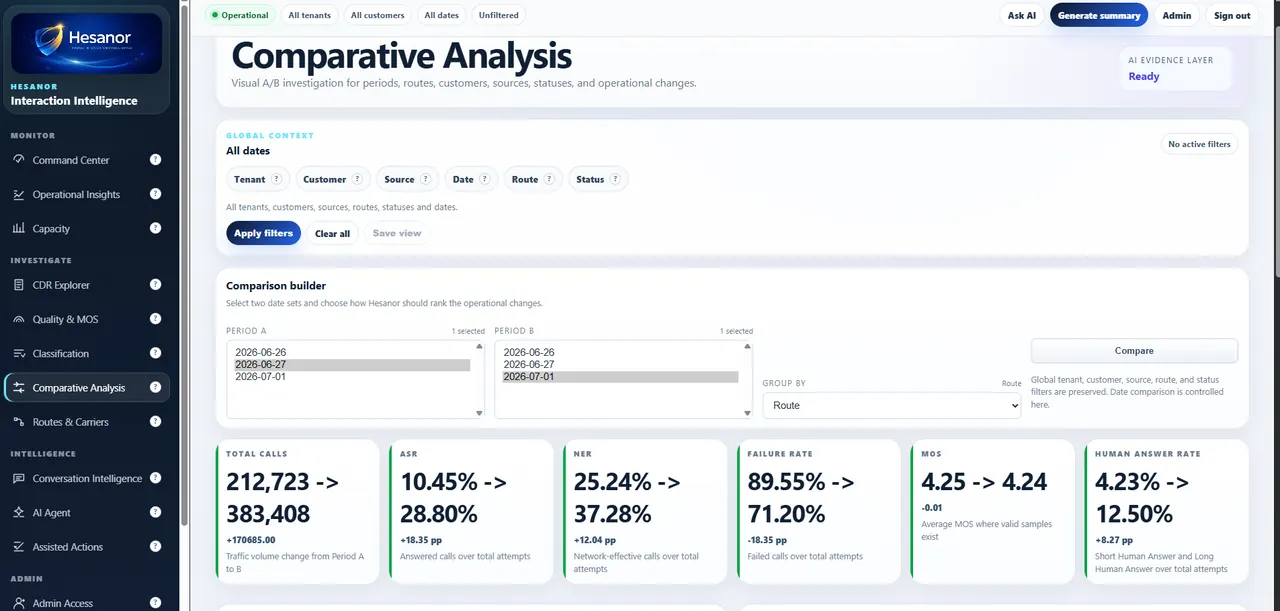
Questions this guide answers
CDR Analytics and MOS Monitoring for Voice Operations
- Which routes or carriers combine low ASR with poor MOS or high setup time?
- Are failures concentrated in a customer, source, status or hangup cause?
- Did traffic composition change enough to explain the metric movement?
- Which calls provide the strongest evidence for technical troubleshooting?
Signals and metrics
Signals and metrics
Practical guides for teams connecting omnichannel interactions, telecom evidence and AI-assisted decisions.
ASR
Answered Seizure Ratio measures answered calls against total call attempts.
NER
Network Effectiveness Ratio separates network-effective outcomes from user behavior where data permits.
ACD
Average Call Duration helps identify changes in answered-call behavior and interaction length.
PDD
Post-Dial Delay measures setup time before ringback or answer and can expose routing or carrier pressure.
MOS
Mean Opinion Score provides a voice quality indicator when valid media samples are available.
Failure causes
SIP status, hangup cause and classification show how and where delivery failed.
Operational workflow
Operational workflow
Normalize
Map different CDR layouts into consistent tenant, customer, source, route and status fields.
Validate
Preview field quality, profile mismatches and suspicious mappings before relying on the data.
Aggregate
Calculate metrics by period and operational entity while preserving drill-down.
Compare
Measure current performance against a relevant historical baseline.
Investigate
Open call-level evidence and rank the routes or customers that explain the change.
Why this approach is different
Why this approach is different
Metrics stay connected
ASR, MOS, PDD, ACD and failures are evaluated in the same operational cut.
Data quality is visible
Profile and batch validation reduce the risk of building conclusions on malformed CDRs.
Multitenant evidence
Every metric can preserve tenant, customer and source boundaries for governed analysis.
FAQ
Frequently asked questions
What is CDR analytics?
CDR analytics turns call detail records into operational metrics, classifications and evidence by time, route, carrier, customer, source and outcome.
What does MOS measure?
MOS is an indicator of perceived voice quality. Its interpretation depends on valid samples, codec and measurement context, so Hesanor shows quality together with scope and availability.
Why analyze ASR and MOS together?
A route may deliver calls successfully but with poor audio, or show low ASR without quality degradation. Looking at both distinguishes delivery and media problems.
Can Hesanor ingest different CDR formats?
Hesanor supports profile-based mapping, preview validation and controlled manual or API ingestion paths for different source layouts.
Continue exploring
Continue exploring
Omnichannel Interaction Intelligence for Contact Centers
Unify voice, email, chat, messaging, tickets and back-office interactions with telecom evidence and AI in one governed data foundation.
Read the guide → Evidence-based operational RCAAI Root Cause Analysis for Telecom Operations
Investigate ASR drops, MOS degradation, carrier failures and capacity pressure with comparative baselines, call evidence and guided AI analysis.
Read the guide → Omnichannel Contact Center analytics guideOmnichannel Contact Center Analytics
Connect voice, digital interactions and operational evidence to investigate customer journeys, service outcomes and telecom performance in one governed view.
Read the guide → Hesanor Aura · AI Agent for Natural VoiceHesanor Aura | AI Agent for Natural Voice and Omnichannel Journeys
Hesanor Aura is a governed AI Agent for natural voice conversations, approved business actions and voice-first omnichannel journeys in Contact Centers and BPOs.
Read the guide → Everyday life / EducationHesanor School
Organize school notices, deadlines and responsibilities in a family workspace. Review incoming information, follow Action Cards and coordinate the routine with students and guardians.
Read the guide →Hesanor
Bring evidence-first Omnichannel Interaction Intelligence into your operation.
Talk to Hesanor about your channels, interaction data, customer journeys, telecom evidence and operational priorities.
contact@hesanor.com