
Evidence-based operational RCA
AI Root Cause Analysis for Telecom Operations
Root cause analysis in telecom is slow when evidence is distributed across CDR exports, SBC logs, carrier reports, dashboards and spreadsheets. Hesanor brings the operational cut into one investigation flow, compares it with a baseline and helps teams rank the routes, carriers, customers, sources and failure causes that changed most.
Updated 2026-10-01
Questions this guide answers
AI Root Cause Analysis for Telecom Operations
- When did the deviation begin and which metrics changed together?
- Which route, carrier or customer contributed most to the delta?
- Which statuses, SIP outcomes or hangup causes explain the failures?
- How confident is the conclusion and what evidence is still missing?
Signals and metrics
Signals and metrics
Practical guides for teams connecting omnichannel interactions, telecom evidence and AI-assisted decisions.
ASR and NER
Measure answer efficiency and network-effective delivery against a comparable period.
Failure rate
Separate answered and failed traffic and rank the failure causes that increased.
MOS and PDD
Correlate quality degradation and setup delay with the same routes and customers.
Traffic mix
Detect whether volume shifts, customer composition or source behavior changed the result.
Route and carrier
Compare operational scores, stability, quality, failure and business exposure.
Call evidence
Drill from aggregated symptoms into call-level records and declared data scope.
Operational workflow
Operational workflow
Define the symptom
Select the metric, period, tenant and operational scope affected.
Build the baseline
Use the previous equivalent period or another relevant comparison window.
Rank contributors
Measure which routes, carriers, customers, sources and causes explain the delta.
Validate evidence
Confirm the hypothesis with call-level data, quality and failure context.
Prepare the response
Generate a technical summary, executive explanation and governed next action.
Why this approach is different
Why this approach is different
Comparative by design
RCA starts with a declared period A and period B instead of relying on visual intuition.
Evidence before language
AI summaries are grounded in the active filters, metrics and available records.
Guided, not autonomous
Root cause playbooks recommend next tests and actions while operators retain approval.
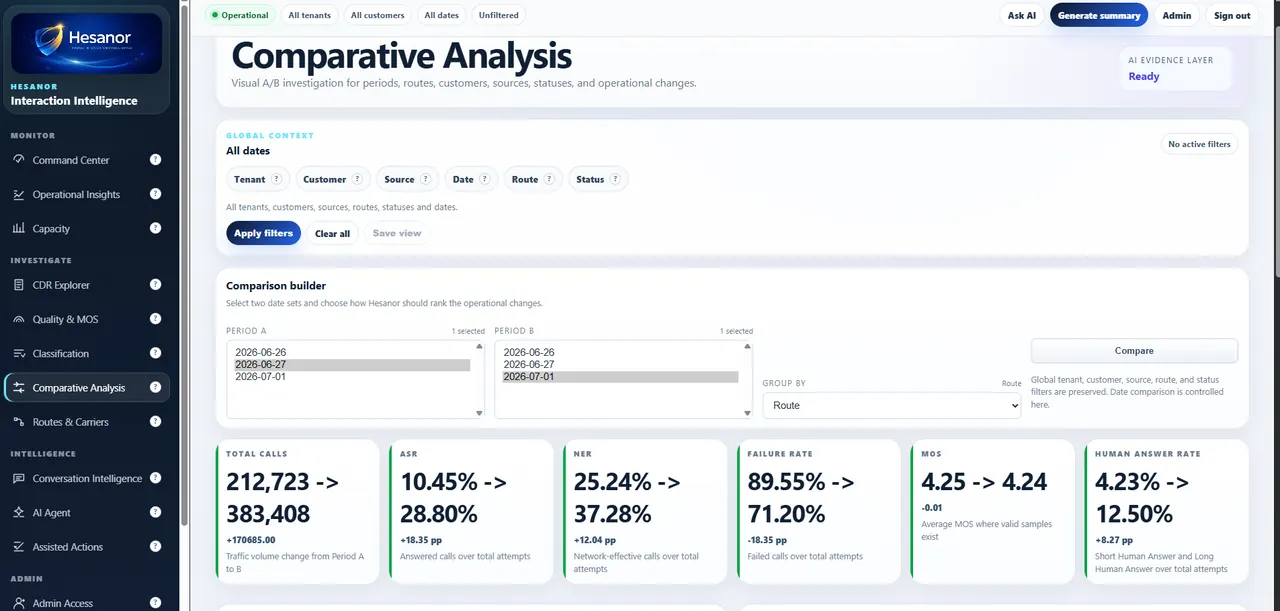
A real Hesanor Comparative Analysis capture
Read the evidence before naming the cause
The displayed comparison shows ASR rising from 10.45% to 28.80% (+18.35 percentage points), while MOS changes from 4.25 to 4.24. These are observations from the product capture, not a customer success claim or proof of a root cause.
Separate delivery from quality
The answer rate changed substantially while average MOS remained close. Inspect sample coverage before assuming voice quality explains the ASR change.
Control the comparison
The periods contain different call volumes. Compare rates, equivalent time windows and traffic mix; retain the same tenant, customer and source scope.
Test the contributors
Group by route or carrier, then inspect SIP statuses, hangup causes and call-level evidence. A ranked contributor is an investigation lead, not a confirmed cause.
Prepare a supported response
Record the filters, baseline, affected entities and remaining uncertainty. Escalate with evidence and validate the result after any approved operational change.
FAQ
Frequently asked questions
What is AI-assisted root cause analysis?
It uses statistical comparison, operational context and generative explanation to narrow hypotheses and present supporting evidence. Human operators validate the conclusion and approve actions.
Can Hesanor explain an ASR drop?
Hesanor can compare periods and rank routes, carriers, customers, sources, statuses and hangup causes associated with the ASR change.
Does RCA require historical data?
A useful baseline requires enough comparable history. When history is insufficient, Hesanor declares the limitation instead of presenting false certainty.
Can the result be shared with leadership?
Yes. Operational evidence can be transformed into technical and executive summaries while preserving scope and limitations.
Continue exploring
Continue exploring
Omnichannel Interaction Intelligence for Contact Centers
Unify voice, email, chat, messaging, tickets and back-office interactions with telecom evidence and AI in one governed data foundation.
Read the guide → CDR and voice quality analyticsCDR Analytics and MOS Monitoring for Voice Operations
Connect CDR analytics, ASR, NER, ACD, PDD and MOS monitoring to identify route, carrier, customer and voice quality issues faster.
Read the guide → Omnichannel Contact Center analytics guideOmnichannel Contact Center Analytics
Connect voice, digital interactions and operational evidence to investigate customer journeys, service outcomes and telecom performance in one governed view.
Read the guide → Hesanor Aura · AI Agent for Natural VoiceHesanor Aura | AI Agent for Natural Voice and Omnichannel Journeys
Hesanor Aura is a governed AI Agent for natural voice conversations, approved business actions and voice-first omnichannel journeys in Contact Centers and BPOs.
Read the guide → Everyday life / EducationHesanor School
Organize school notices, deadlines and responsibilities in a family workspace. Review incoming information, follow Action Cards and coordinate the routine with students and guardians.
Read the guide →Hesanor
Bring evidence-first Omnichannel Interaction Intelligence into your operation.
Talk to Hesanor about your channels, interaction data, customer journeys, telecom evidence and operational priorities.
contact@hesanor.com